Pages

Showing posts with label Chronicles of Sebastian. Show all posts

Thursday, 12 March 2015

Chronicles of Sebastian: We Celebrate YOU!!

Guess who?!
Today we are taking a break from our weekly Conversations with One to celebrate a very special friend of the blog and a young man that is no stranger to many of the regular readers, particularly for those who followed his very popular series - Chronicles of Sebastian.

The famous picture! lol
I remember telling the story of how I 'met' the wonderful Sabba Sabba as he is fondly called and till today, when I think of what I refer to as the divinely orchestrated meeting with this great great friend, it still amazes me and I am reminded of how God answers our 'Big' and 'small' prayers.

Long after that email, Sebs has continued to be a solid friend. A man who clearly loves God and demonstrates it in many ways.

Sebs, I don't know how to thank you enough for being a gracious and kind-hearted friend (This is further evidenced by the friends you seem to 'collect' from places you've visited or lived around the world, and you still maintain the friendship so well!).

Friend to many!
Here's wishing you the happiest of birthdays and praying that God will richly bless you, grant you your heart's desire and make this a very special year for you indeed in Jesus name. May you continue to delight yourself in God and may He continue to glorify Himself in your life.

Have fun, (I know you will!), dance (I know you can, lol) and celebrate your day in style!

God bless and lots of love.

Sabba Sabba!

Wednesday, 17 December 2014

Chronicles of Sebastian - A Star in the Night

Hello everyone!

Guess what?! We have another special guest star appearance by Sebastian! It's always a delight to receive a guest-post from him as I am sure just like me, you have missed the rich and funny Chronicles of Sebastian series where Sebastian shared with us weekly, his experience of him being a German student in Enugu (Nigeria) for 6months! So here goes wonderful people, another fantastic one 'A Star in the Night' by Sabba Sabba :-)

***********************************************
LIGHT up for Jesus!
There were many things I loved doing in Nigeria. One of them was "star-gazing". There’s nothing quite like going out at night, sitting down, listening to the crickets and the frogs and watching the beautiful sky. With the mortar waking me up in the morning, the heat making me suffer at noon and all the chatter I enjoyed throughout the day, I really loved the quiet of the night. I know the quiet-thing doesn't work so well in "Lag" and even in Enugu it was sometimes not that calm at night, especially when in some night vigil, the preacher next door stretched the microphone’s capabilities by repeating "FIRE! FIRE! FIRE! SEND DA FIRE!".

Okay, back to the quiet lol… I've also prayed-oh! But especially at night it was more a calm prayer, when I reflected on the day, thanked God or just watched the stars. Particularly when NEPA took the light and there was no fuel for the gen, you could see the stars so clearly. If you’re in a village, star-gazing works even better, since there is less "light pollution" brightening up the sky with artificial lights. Spending Christmas in a village is probably a good opportunity for watching a clear sky. Now for all you romantics out there, doing that with your S.O./MGM (I’ve learnt all of these terms here on the blog! hehe) is probably a much more magical experience!

In Philippians 2, Paul uses this imagery of stars and night. He calls us to “shine like stars in the night”, night being a "twisted generation" (bad world), lights being us. Okay, now you might ask yourself, how do I do that? How can I be a light? By suffering for Jesus? Being an acclaimed pastor? Fighting poverty? Ending corruption? What does Paul say? Ready?: "Do all things without grumbling or disputing!" Wow, who would have expected that? "BE A LIGHT!!" How? "Don’t complain". It sounds too simple, too ordinary.

Yet, it is so true! We complain so much, don’t we? About bad service, annoying friends, uncomfortable situations, family pressure, the government, the weather, our work, our life, ourselves. I've heard that 30-40% of our conversations are about complaints. This number may vary from culture to culture, but I've found that people complain everywhere and in many situations - school, church, home, when we chat, jam bodi, etc. - we all be "gra gra" at times.

However, God wants us to be different. He wants us to be positive, to work without grumbling, to talk without nasty overtones, to not beef each other, to smile genuinely and to have a generally positive outlook at life. Because this can be so hard when we think we have all the reasons to complain, so here are some tips to fight complaining:

Smile, no grumbling today :-)
1. Let God work on your heart. You all know this, "out of the overflow of the heart the mouth speaketh"… God does not want us to put on a fake smile while deep down we resent everything. Complaining is usually a symptom that we are not satisfied with something, whether with small things or the world at large. Only God can give us a deep sense of contentment that goes beyond circumstances. He can help us by giving us the patience to cope with situations that we are not happy with or in control of; He can remove the pride in us that we always want to have it "our way" and when life or specific people or services don’t cater to us. We can honestly tell Him what’s on our hearts, we can lament and then ask Him to change us.

2. When you complain, have an aim. Not grumbling does not mean we can never utter criticism. Of course things need to get better, people misbehave, companies do anyhow: there is always room for improvement. But your complaint needs an aim - an aim to make it better. You can tell a friend what he or she is doing wrong and how he or she can avoid that in the future. That serves the person more than calling him or her "Idiottt!" and gossiping about him. If you don’t like something about your work, try to talk with your boss or your colleague about possible solutions. Now I know it’s not always that easy - fear, pride or emotions can come into play. In Nigeria, some debates end up in a huge quarrel where everyone talks at the same time in all sorts of languages, which actually looked quite funny from the outside… lol But even though it is sometimes hard to improve things, we should try to focus on solutions instead of just whining and doing nothing.

Correct in love :-)
3. Dwell on and share good things. You might ask, "But Sabba, what can I talk about if I don’t complain?" A couple of chapters later, in Philippians 4:8, Paul gives us an answer by encouraging us to "think about whatever is honorable, lovely, commendable etc.". Sometimes we can be so drawn to the negative that it is hard for us to talk about good things. But there is so much to talk about! Share a good story, show what a friend has done for you, what you have experienced or learnt, tell a joke etc. The key is to  redirect" your emotions and to focus on something or someone else. If you feel like grumbling, you can also just have a good conversation with someone and be genuinely interested in the person you’re talking to. This way you can often get a new perspective and forget about yourself for awhile.
Hehehe...
This very blog here is an excellent example of how all of this can work in practical terms: Not only through Ayo’s lovely posts, interviews and convos, but also through your comments, the blog’s positive spirit shines through! There is so much encouragement and hope that can be drawn from here. If we practice that in the real world as well; if we, in our individual lives, try to offer hope instead of grumbling, encouragement instead of harshness, purpose instead of cynicism and patience instead of frustration, we can be bright lights in the night. And even if you still have to watch the stars alone, just by being this kind of light in your environment you can already create "magic" in other people’s life. :)

**********************************************
Another beautiful piece from Sebastian with a lot of wisdom and lessons from everyday activities! Thank you Sebs for this great reminder that God wants us to be His light here on earth. 
Like Sebs said, living in this world and holding yourself from complaining/grumbling is TOUGH! But that's what God asks of you and me. Let's start consciously practicing it, asking God for the grace to represent Him well!
************************************************

For all previous Chronicles of Sebastian posts, please click HERE
Also, you can visit Sebastian's blog http://seb2nigeria.wordpress.com/ It's in German, however you can use 'Google translate' if English translation is required - Lovely lovely blog!

Remember you can send an email: oneplustheone@gmail.com
Follow on Twitter: @1plustheone
Facebook: www.facebook.com/1plustheone

Wednesday, 8 October 2014

Our Fantasies and His Faithfulness - On Dreams, Realties and the Challenges-in-between (Sebastian Luling)

Guess what?! Today, we have the pleasure of one of our favourite guest series writers of the Chronicles fame, with another interesting, witty and deep article.. Ladies and gentlemen, it's no other person but Sebastian Luling!!! *rings bell*

Sebs aka Sabba Sabba, it's always great to have you on 1 + The One!

I bet that you will enjoy this one.. Happy reading!

********************************************************

Hello dear readers!

It’s me again, Sebs! Happy new month! Kedu? Bawo ni? < Ayo taught me this one :-). For those who 'no sabi me', my name is Sebastian, a German who wrote some “Chronicles” about my experiences in Nigeria. Since I finished the series, a lot of nice things have happened!

First, Ayo started an amazing new “Convo” discussion series shortly after the “burial” of mine: Ehen, when I think about it: Sometimes old things need to go so that new ones can start, don’t you think?
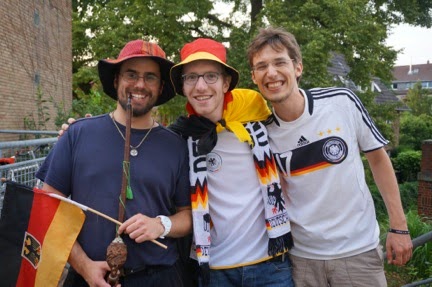
Germany won the World Cup, which was an amazing experience that actually got even the reserved Germans very excited. There was a lot of dancing, flag-waving and a sense of togetherness. But I suppose it didn’t quite match a Nigerian owambe (Ayo again!). :-)

Germany - Football World Champions!
I got to meet super-friendly Nigerian novelist Lola Shoneyin during a book reading. Chai, that woman has power!

Just recently, my sister got married! Since this blog mainly focuses on relationships, I thought I could share some stories and lessons from that event. 

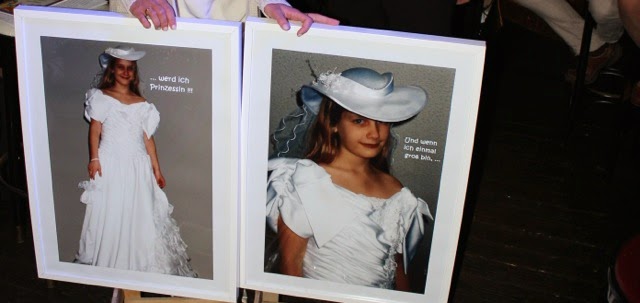
Before and After :-)
See these two pictures? This is my small sister Sanni acting as a bride in her admired dress that belonged to one of her favorite aunties (aunty in the Nigerian sense :-)). She always loved to dream about her own marriage and being the expressive-speak-her-mouth kind of child she was, she also revealed whom she wanted to marry: First, she wanted to marry me her brother lol, then after some more understanding it was Robert, then Jürgen and finally she ended up with Carsten, whom she actually befriended and after 14 years of an up-and-down relationship, married at the age of 29 (don’t worry, age is not a huge secret in Germany lol). 
Then and Now!
Now these pictures were part of a wedding present from my oldest sister (Sarah) to Sanni (the bride, and yes, our names all start with S lol) to show her how long her little sister has been waiting for this wedding day. She unveiled it during a moving speech about their sisterly childhood and teenage memories. While she presented the old pictures and told their stories, I was both moved and also somehow carried away in my thoughts: I was suddenly so aware of how much has happened in my dear sister’s life between these old childhood dreams of being a princess and her actual wedding over 17 years after.
As a brother, I’ve witnessed first hand what happened in these 17 years: Silly laughter, stupid arguments, reconciliations, insecurities, difficult decisions, conversations about decisions, gisting around the dinner table and loud music in the car. Now, at her wedding, not only did her wedding dress turn out to be different, her whole life took a different course from what she might have expected. I felt so happy that she finally got married, realizing how much she went through. It’s almost like in the movies when you appreciate the happy ending all the more due to all the wahala they went through before.


I believe these observations of childhood dreams and the struggle in realizing them translate to many other areas: When people are young or when they are about to start something, they can be as dreamy and confident as my sister back then. It is the confidence of …
… a football team at the beginning of a World Cup or any other tournament,
… little primary school children thinking they can do anything in the future,
… someone launching a new project, a series, an idea,
… a madly-in-love girl who feels she could hug the world.
Usually, these people start with the excitement of the new. Yet, when the first challenges arise; the difficulties when…
… you lose your first game,
… you do badly in school,
… your project is not going well,
… you discover some major flaws in your loved one.
… then we can easily lose sight of our dreams and of God’s plan. It all seems so wearisome that we can get into a mere passive survival mode, a mode where we somehow keep going, yet stop to thrive, to smile, to laugh, to hope, to reach out. 

I feel that especially in Nigeria, a country with so many brilliant and talented people having so many individual dreams, but people who sometimes lack the opportunities, resources or connections to realize them, it can be difficult not to lose hope. I sense this also when I talk with 'diaspora Nigerians' here in Germany, when they start talking about their home country, they express this tension between what is … and what could be, this sense of nostalgia mixed with frustration. 

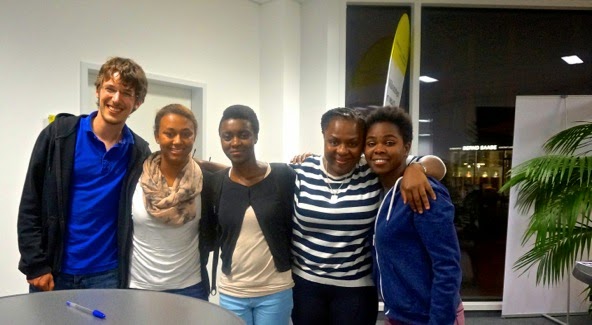
With some of my Nigerian friends in Germany
So what can we do? Well, I don’t have all the answers, but one thing I know for sure: God has His plans for us, and they surely include disappointments. Joseph had nice dreams, but he also had a not-so-nice cell in which he had to live before his dreams came true. Jesus had a mission, yet he knew opposition, betrayal and misunderstanding would be his portion before achieving that mission. Still, both of them did not lose their confidence and hope. That is the tricky part: To go through wahala, yet not to say “I don tire”. To endure, not just with resoluteness, but with hope and joy. To fall down, and get back up again. To be vexed, and still forgive. To look at some old pictures and start to dream again, but to remain open for a “change-of-plan”. To let God give you the energy, patience and strength to do all of that.

When I read through some of the comments on this very blog, I can sense the hopeful outlooks of many godly sisters, women who, inspired by other role-models, hope for the best and who believe that God will provide them a good husband and a blessed marriage. It is refreshing to see this enthusiasm and this energy. However, I don’t know about the ones who don’t comment and the doubts and disappointments every one of us might have had, especially in this area. But I pray and hope that we don’t lose hope, joy, and this sense of excitement. That, like my sister, one day you can look back at your troubled life and smile about the past dreams, rejoice in reality and look forward to what’s next.

Me, when life was a lot simpler :-)
*******************************************************

And I say a big AMEN to that... Thank you for this brilliant encouragement and reminder to never stop dreaming and to never give up on our dreams.. They may change slightly (or totally!) but as long as God's in control, it would always be better.

Congratulations to your sister and her husband.. May the reality of their marriage surpass their dreams or imaginations!

"Now unto Him that is able to do exceedingly abundantly above all that we ask or think, according to the power that works in us" - Eph 3:20

Keep hope alive!

Thursday, 19 June 2014

Chronicles of Sebastian - Knowledge, Love and its Connection *Curtain Falls*


I know this blog covers a lot of 'heart things' - emotions, relationships, friendships etc.. Today, we’ll move a bit up the body towards the head, to talk about knowledge, the mind and wisdom. When it comes to knowing stuff, I observed that we tend to go into extremes - if someone knows too little, he is labeled as being an “imbecile” without having “number 6”, yet if someone knows a lot, they are sometimes accused of reading “too much book” or maybe even of being arrogant. In universities and churches people complain that there’s a wide gap between theory and practice. We know that knowledge is somehow good, but people in history and present times are often ultimately assigning more value to feelings and practical things. However, I firmly believe that it’s not “either heart or head”, but both “head and heart”. We were created to love God and people with everything in us - our heart, mind and soul (Mt 22:37). Knowledge, if dealt with properly, can actually lead to more love and affection. So let’s have a look at how this can be possible:

1. Be Curious. Some people wondered whether I really just stayed for one semester in Nigeria. Now, I no be lying, I really just spent a few months in Nigeria, although these months were really intense. I think one thing that helped me in learning much in a short time was my natural curiosity. As a small child, to the dismay of my parents, I often broke their technological things by experimenting with them. Even when we grow older, I believe we should still be curious about the world around us. Back in Naija, I asked myself questions such as: "Why are things done this way?" "What is on the mind of this gateman?" "Why do birthday guests “clean the chair” with money?" "Why do most people vote by tribe and not by party?" "How do people perceive politics?" "What is this 'NYSC' that everyone is talking about and what are they doing there?" "Why do so many sellers never have "balance" (lol)?" "What is the difference between garri, eba and fufu?".
Be inquisitive, be interested and explore the world around you with a sense of wonder - there is so much to learn if we’re willing to take the eyes off ourselves. The funny thing is that you will actually learn more about yourself by interacting with others, since contrasts help us to be aware of who we are.
Even in a relationship, curiosity is a great tool to know your partner in a better way. What does he or she like? What makes her tick? How does her family differ from mine? If you stop being curious about your spouse, you’re essentially saying “I got you, there is nothing I need to know anymore”. I always feel honored when friends ask me questions about myself, it signifies interest and care. At the same time, I don’t like people who are so sure about who I am that they put me into a box and leave me there suffocating … lol.
Education and knowledge might frighten some people in Nigeria (e.g. Boko Haram), since educated people can question the status quo and think for themselves; but as much as possible, never let anyone drown out your curiosity abeg.

2. Read non-fiction and fiction books: See these books? 

Chai! Diarris...
In order to write a term paper on my experiences in Nigeria, I went through some of them. Reading them was such an interesting and eye-opening experience! You see, if you just read news about a country on the internet, you only get a superficial view - Boko Haram, kidnapping and other catastrophes. But digging history and “yesterday talk” really helped me to see how past events impact nowadays life in Nigeria; how artificial colonial borders put together many different tribes into one country, how the discovery of oil boosted both economy and corruption and how many other things are related to history.
While non-fictional books help us to see the “big picture”, reading fiction (such as Chimamanda Ngozi Adichie’s novels) enabled me to enter “someone else’s mind” and see their world through their eyes. I was often so immersed in African novels that I felt I connected and sympathized with them and their way of thinking. Once you read novels, you’ll learn a lot of “emotional truths” which can shape the way you interact with real and actual human beings. I often find myself being a little less judgmental and more understanding of others when I just finish a good book.
PS: I know books can be expensive, but I borrow most of my books from the library or buy them electronically (Kindle books are far cheaper than real ones). In Nigeria I also found a lot of pirated copies to be fairly cheap, but it’s up to your conscience to decide whether you like to get them. :-)

3. Process your thoughts by presenting them to others. “Thoughts disentangle themselves passing over the lips and through pencil tips." Once you try to explain someone else what you think or feel, you are forced to make your foggy thoughts somehow understandable by breaking them down for others. That process is immensely helpful and reason enough for talking (and writing) openly with others and not just keeping everything for yourself. Writing these “Chronicles of Sebastian“ has helped me personally to be aware of what I’ve experienced and learnt. I had to force myself to think: “Yeah, what did I actually learn about Naija worship / love / time etc.?” The same goes for spiritual truths: I remember my own spiritual lessons best by sharing them in sermons, conversations, writings etc. If I just keep everything to myself, I’ll suffer “spiritual obesity” :-)
So I would like to encourage you to write down your experiences and thoughts (e.g. in a diary), to jot down your “spiritual takeaways” in sermons or your “quiet times” and to, if appropriate, share some of your thoughts with good friends or even publicly (e.g. on a blog). It really sharpens your thinking.

My oldest sister gave me a map before my trip to Naija :-)
4. Be an expert in one or two areas. We all know how to say a little on politics, relationships or money. In order to go beyond the superficial and the general, you might need to specialize in a few areas you care about.
You really love the dynamics of relationships? Go ahead, become an “expert” - ask people, go on conferences, read books, structure your thoughts, help others. Personally, I love everything African and I aspire to know a little more about the continent and its people than most Germans do. For example, yesterday I went to a reading of the Kenyan author Meja Mwangi, who came to my city to read from his book “Rafiki”. It was interesting to notice differences between Kenya and Nigeria. Other people might be passionate not so much about cultures, but about businesses, family, natural hair or education and that’s totally fine. Do your thing, become better in it and help people to be successful in this area. 

Be an expert in your field
5. Acknowledge your limitations. Paul warns us that “knowledge puffs up, but love builds up” (1 Cor 8:2) The more we know, the more we are prone to put our trust and our pride into our knowledge. Before going to Nigeria, I went to Senegal. Now I intentionally had to force myself to not just trust my prior experiences. I could have just said “I know now, how things work”, but it was good to admit that I needed to start afresh, to “re-depend” on God again, to come to Nigeria with a teachable attitude.
The same principle applies to the opposite sex: My lovely sisters revealed many mysteries of how women think and act. Yet, once I left my home and started talking with other girls, I noticed how different each woman still is and how I cannot really apply my general knowledge to every girl in the world. I had to learn to see each girl and each person as an individual instead of pretending to be the “know-it-all”. In Nigeria as well as in Germany I have met some people who are so sure of what they believe (about denominations, other tribes, other people) that they never even consider other voices. That’s dangerous, since the moment we stop listening to and learning from others, conflict and pride are just around the corner.
Considering all the things we don’t know yet, I believe we just have to confess that we “no sabi nothing”. This will keep us humble and teachable. Don’t trust your past, your experience, your money, your self-help books or your wisdom - be “soft clay” and trust God instead. 

My lovely sisters and I
6. Use all your knowledge and experiences to the glory of God and the good of others. You can only love someone you know. Humans naturally don’t care about strangers. Thus, the more you desire to know God, His attributes, His works, His ways, His creation and His people, the more you begin to wonder and appreciate Him for his great power, creativity and for the gifts He bestowed on us. So don’t just read the Bible, read it with a sense of expectation and amazement, just as you try to get to know a loved one :) 

With some great Nigerians I met in Germany
After coming back to Germany, my prayer was that I would be able to use my knowledge and my experience to the good of others. I am immensely grateful that He answered my prayer and opened up some doors in Germany (e.g. speaking at conferences) and led me to some really kind Nigerians in my environment. He also used Ayo to encourage me to write for this blog and I hope that my write-ups have blessed or encouraged you in one way or the other. Unfortunately, I’ve decided to “call it a day” and finish the series for now. I’ve tried to pass on some of the most important experiences, observations and lessons I’ve learnt. Recently I sensed that I’ve exhausted the little knowledge I got, so I thought it would be wise to end it here.

Once again I want to thank all of you for reading my stuff, for supporting me, for writing comments and for creating a lovely atmosphere here. Your contributions really helped me to keep up the work for three months!
I will keep on reading this blog and try to contribute to this awesome community to the best of my ability, so we won’t have to say good-bye for good :-)


So finally, let me share my last point:

7. Know what’s truly important. At the end of the day, there is a lot to know about and a lot of things we will never know. Our minds and our time are limited; so in order to live your life well, you need to know what you ought to know. So what really matters? What do we leave behind? Looking back at Nigeria, at my life; I think of the faces of people that I’ve met, the encounters we had and the memories we created. The moments of joy, the winks in class, the stories we shared, the hug in the end. Then, I think of someone less visible, of someone whose face I’ve never seen - Jesus. The man who made all this possible, who changed me into the man I am now, enabling me to meet and truly love all these people in the first place, by saving me, from my sin, my pride, my self-centeredness and my idols. Knowing Him, and knowing all those He created and loves is what really matters. To do that, we might need to read, to ask, to look and to learn – learn about all the ways in which we can know and love Him and others better. But ultimately, it’s just that: knowing Him, and knowing them. And since true, intimate and heartfelt knowledge leads to the love we were made for, the love we ought to appreciate and the love we ought to share (1 John 4:7); go for that knowledge, the knowledge that really matters.

Thank you very much and God bless you :-)

Sebastian


*****************************************************

Wow.. What an amazing way to end the series Sebastian *standing ovation*.. 
I have met many great people in life and I will definitely count Sebs as one of them. Even though I have actually never met him face-to-face, I have been truly blessed to know this wonderful and kind-hearted man who is consistent in his encouragement, humble, very reliable, open and has such a heart for God.
When he told me that the series was coming to an end as really there's only so much that one can write about a 6-month experience, I sent him a one-line response "Noooooooooooooooooooooooooo" lol. The answer hasn't changed but I understand the wisdom of his decision :-).. 
Thank you Sebs from the bottom of my heart for being a blessing and for yielding yourself to be used so greatly to be a blessing!

**********************************************************

For all previous Chronicles of Sebastian posts, please click HERE
Please visit Sebastian's blog http://seb2nigeria.wordpress.com/ It's in German, however you can use 'Google translate' if English translation is required - Lovely lovely blog!

Remember you can send an email: oneplustheone@gmail.com
Follow on Twitter: @1plustheone

Wednesday, 11 June 2014

Chronicles of Sebastian: Story Story... Precious Guidance in Nigeria (Video post!)

Have you ever wondered how as Christians we are supposed to know where to go next? How does this "guidance" thing exactly work? Well, I don't have a clear-cut answer for that complex question. What I do have are some stories of how I was led into some interesting situations while I was in Nigeria. To tell these stories properly, I decided to move away from my usual lists and to shoot a short video instead:


Some might think it's all coincidental, but I leave the interpretation up to you! :-) Please leave a comment if you have your own stories to tell or if you want to debate some issues raised.

If you were unable to watch the video or in case you prefer the "written Sabba", don't worry: Next week's post will include some more text!

Until then - all the best :)
Sabba-Sabba

PS: Apart from Germany, I'll cross my fingers for Nigeria in the world cup :-)

***************************************************

Oh this has got to be one of my favourite Sabba posts.. I loved being able to relate with him on a  more 'real' level lol.. Almost like being 'properly properly' introduced to the man called Sebastian.. He's even funnier in person than his writings (and that's a tough one to beat!).. And very clever too! (Now we have a video post Sebs, next up is meeting in person! I think it will be an absolute hit! I would probably laugh till I cry!)
Also, it got me thinking about the many 'coincidences' that are actually God orchestrating events in our favour. It's beautiful when you look back and think about how God brought it to pass..As in my God is just too 'on point'.. He brings people our way just when we need them, He answers our prayers in so many diverse ways that we can't put Him in 'a box', His ways are so different from ours yet the results so much better than what we imagined :-)
I remember how He introduced me to Sabba HERE and I can't but be amazed and be grateful for Him being ever so mindful of us all - Thank You Jesus!

*****************************************************

PS If you missed the very end of the video (like I almost did, Sebs gives a very important announcement :-( ... Let me know what you think) xx

For all previous Chronicles of Sebastian posts, please click HERE.. Join Sabba again next week Wednesday..I look forward to what he will be sharing with us!
Please visit Sebastian's blog http://seb2nigeria.wordpress.com/ It's in German, however you can use 'Google translate' if English translation is required - Lovely lovely blog!

Remember you can send an email: oneplustheone@gmail.com
Follow on Twitter: @1plustheone
Facebook: www.facebook.com/1plustheone

Thursday, 5 June 2014

Chronicles of Sebastian - Now You're Talking!!

A few weeks ago, Nigerian’s First Lady Patience Jonathan gave an emotional speech on the Chibok girls that sparked a great controversy. The issue was not necessarily what she said, but how she said it. She used Pidgin English, asked “only you waka come?” and ended her speech with her now famous exclamation “There is God-oh!!”. While some Nigerians thought that her choice of language was rather inappropriate for a First Lady, others felt this made her appear more genuine.

                                                  
                                                                   Source
Whatever your opinion may be, the discussion shows the significant role language plays, especially in a multilingual country such as Nigeria. Whether consciously or unconsciously, language shapes our way of thinking and perceiving the world and people around us. So let’s take a look at some “language lessons”:

1. Words can have different meanings in different contexts. In my first weeks in Nigeria, I got confused by a lot of words. Someone asked me “How far??” and I asked him “How far is what from what?”. Then he was like “Jeez man, how are you doing?”. Another friend told me “I am coming” and off he went… lol When a fellow-students asked me which courses I am 'offering', I told them that I’m just a student, I don’t offer any courses. Only later did I realize that they were probably talking about taking courses. I could go on and on: How I thought “taking a bath” means lying in a bathtub, how 'reading' is not just restricted to reading books, but studying in general; how NEPA and light are synonyms for electricity; how passport is not your ID, but a picture of yourself; how brother/daddy/aunty are often titles and not just family members; how “having tried” is a recognition of success (not of a failed attempt), yet how “Well done!” does not actually refer to accomplishments; how “flashing” people has nothing to do with torches, how “taking a drop” makes your taxi ride more expensive… You get the idea, as a foreigner you just have to get used to all these shades of meaning. I had a lot of fun making mistakes and learning these gradually. 

2. Nigerians love code-switching! As in, they switch between many languages effortlessly. A LOT. Whether in everyday conversations, songs or sermons: My German mind was bewildered by all these different languages in just one or two sentences. When I first heard the beginning of “Mma Mma” by Frank Edward, I thought “nice, an English song I can understand”, until the song went on: 

You lifted me
Then gave me a song
Agama turu gi mma mma
Knowing that 'mma' is a flexible word for basically anything good and praiseworthy, I somehow figured things out and continued singing…

Once, while I was taking notes in an English sermon, a priest suddenly struck up an Igbo song. When the congregation also joined in cheerfully, I was like “Wetin dey happen here?” lol… I think the frequent code-switching reflects a general attitude of not bothering too much about fixed rules, of living rather free and improvised than strictly in one certain way. It’s a token for the diverse colonial and pre-colonial factors and circumstances influencing Nigerians.


4. Nigerian text messages require serious reading. Another challenge: texts and facebook messages. I’m telling you, after I received my first heavily abbreviated messages, I was like “Chai, this is not easy-o.” They went something like this: “Lngst tym. Hw r ur ppl? u thnk dis s a gud idea? dnt u av class nw? Im wf my gf now. xpktn u at church tmrrow. slp wel”.
It took me some time to decipher these messages, but wf tym I gt betta at d readng nd nd, bt I stl nid hlp 2 wrt lyk dat. :-)

5. Learning another language helps you to connect. Admittedly, I don’t know much Igbo and Pidgin. All I know are just a few chunks I’ve picked up along the way. Yet, even these small phrases always made (and still make) Nigerians so happy. When I use kachi fo instead of just “Good night!”, many of my Igbo friends burst into laughter. Just recently I met a Nigerian who didn’t know I went to his fatherland. So when I asked him abi? in the midst of our first conversation, he was puzzled and started to laugh with his new “broda”!
You don’t need to be perfect, but by using a few high frequency words of a foreign language, people will appreciate your efforts. It’s just a small token that you care about their culture, making it easier to connect with them. 


6. Speaking Pidgin and slang can be great fun! Learning some Nigerian words and idioms did not just help me to connect with people, but also with the lifestyle and the culture at large. Many Nigerians have this rough way of speaking and writing, this no-nonsense approach without much “beating around the bush", a clarity and confrontational style that I had to get used to, but now I’m beginning to love and use myself. For instance, if you believe someone spends too much time on education, you can express that by saying, “In my opinion, her idolization of education seems unbalanced.” In Nigeria, you can just say “She reads too much book”. It may express the same idea, but the latter just sounds funnier and more straight to the point. The same goes for “The sun is too much!”, “She is looking for my trouble-o”, “Rain is beating me”, “doing anyhow”, “you’re shining!”, “be going” (or carry go), “Wetin concern government”, “419!”, “I will slap you!”, “Lai Lai”, “God forbid!”, “You don’t mean it!” etc. They signify a rather rough approach to life.

Back in Germany, some of these phrases are often on the tip of my tongue, yet I obviously cannot use them. If my friend tells me something bad, I wish I could say “Eh-ya”, but he wouldn’t get it. Sometimes I still say “Yes now!” emphatically or I add an “o” to the names of my friends (Steffi-oo), since this way of engaging people and using emphasis has become part of me.


7. Language is a way of identifying yourself. If Nigerians want to appear before the Western world, they speak English. Among the family in the village, most people switch to their native tongue (Hausa, Efik etc.). In busy towns or among peers, “broken” is often used as a lingua franca. When some parents don’t allow Pidgin in their home or constantly speak English to their children, they thereby also make a political and personal statement, signifying where they (wish to) belong.
I believe that all languages have their own benefits: English opens up a wide door for education, for interacting with people from abroad, for consuming English books, movies, songs etc. The ethnic languages carry the cultural heritage each tribe has and help Nigerians to identify with their roots (that is why Chinua Achebe uses a lot of Igbo words in his novels). The advantages of Pidgin and slang are outlined above.

8. We need empathy to communicate well. I strongly believe that empathy, the ability to put yourself into someone else’s shoes, is a core virtue that really helps us to understand each other and to avoid a lot of conflicts. Being able to adapt to another person’s language and the way he or she uses it is a key component of good communication. Example: We once had a white lecturer coming to our university in Enugu and I remember how my friends did not really understand him. The way he presented his topic and interacted with the audience, his choice of words: all of that was not wrong, but just not appropriate to the context. 

Oftentimes I could tell from the (lack of) nodding and the facial expressions whether my Nigerian conversational partner really got me. The longer I stayed, the more God helped me to use my speech, intonation, words and trains of thoughts in such a way that I could get my points across. This required a lot of close listening (not close marking though lol ;) ) and a general commitment to good communication.
This applies to many situations: talking with someone of lower education (who might not understand fancy words), talking with an elderly person (who might not know technology well), talking with a non-Christian (who does not know why people cover things with the “blood of Jesus”), talking with a foreigner (who wants you to speak slowly so he or she can get you)… God tells us to love all these people and one way of doing so is by trying hard to understand and to adapt your speech and actions to their personal understanding and environment.
Jesus models that perfectly: He got along with the lowest of the lowest, but He could also talk theology with Nicodemus. He constantly used images and parables from the Jewish environment he lived in. His speeches were powerful (Matt 7:28) because they were clear and full of grace and truth (John 1:17). May He empower us to use the language(s) He gave us wisely and powerfully :-)

********************************************************
Amen and Amen to that Sebs. Thanks for another wonderful and humorous post and for bringing home the importance of using communication as a powerful tool for showing love and being neighbourly - even in the simplest of ways. 
It was really funny reading all the phrases and words Sebs picked up from Nigeria, I had to ask him if he was really sure he spent only 6months in Enugu! :-D

************************************************************

For all previous Chronicles of Sebastian posts, please click HERE.. Join Sabba again next week Wednesday..I look forward to what he will be sharing with us!
Please visit Sebastian's blog http://seb2nigeria.wordpress.com/ It's in German, however you can use 'Google translate' if English translation is required - Lovely lovely blog!

Remember you can send an email: oneplustheone@gmail.com
Follow on Twitter: @1plustheone
Facebook: www.facebook.com/1plustheone

Wednesday, 28 May 2014

Chronicles of Sebastian: The Nigerian Mother - SUPERWoman (For You, 'Princess Lulu')

In my 'Chronicles' (gosh, this term makes me feel so old! :-)) we’ve already talked about Love and Relationships and The Beauty of Friendships. This week, we move on to yet another very important relationship – that to your mum!

Ayo’s mummy celebrates her birthday today! So, I want to take this opportunity to congratulate her. 

Ayo's Mummy :-)
Now I have never met Ayo’s mother, but I still want to extend my special greetings to her: You must be a truly amazing woman, ma, considering the excellent home training your daughter must have received! Let’s be frank, Ayo is an astounding woman, isn’t she? Her writings, prayers, comments and I’m pretty sure her life as well speak volumes about her God-fearing, virtuous, sociable and warm character and since “a child is what you put into him” (according to a Nigerian proverb), her mum must have been (and still is) a wonderful role model, turning Ayo, her devoted brother (willing to sacrifice himself for his sick mum) and her other siblings (one of her fab sisters described here into the blessings they are now! 
In celebration of Ayo's mummy's birthday, here are some general attributes I’ve observed in many of the good mums I have met in Nigeria:

A Mother's love is so beautiful
1. Many Nigerian mothers work so hard. No matter where you live in Nigeria, in case you’re female, married and have children, there’s probably not much time for you to develop an “idle mind that is the devil’s workshop” (yet another 9ja-proverb:-)). You gotta do the shopping, put food on the table, clean the house, care for your husband, your (oftentimes numerous) children, visitors and others. Depending on the family’s means, mums also need to improvise a lot in handling challenges with limited resources (e.g. carrying a baby on her back instead of giving it away). They’re physically strong, magically balancing big pots and other heavy stuff on their head (I failed miserably trying that ;) ). If you belong to the Tiv-tribe, you could be expected to do some farm work and as a Yoruba you might also need to balance a job and house chores simultaneously. In any case, many mums in Nigeria are up from early in the morning (in my Enugu campus where I stayed, the steady mortar sound sometimes woke me up at 4:30am -.-) to late in the night and I admire their strength and endurance to keep up this kind of workload for decades. If all Nigerian women went on strike for a few days, the whole country would collapse and people would die of starvation - to my mind, women are the true pillars of the house. While some men would “suffer seriously” or flee if they had to face these motherly challenges every day :-), Nigerian mums just stand strong and keep it up.

From the moment we're born, the work begins in earnest and there's no retirement age
2. Most of them do the work humbly and without complaining. Apart from the amount of daily work Nigerian mums get done every day, I am astonished how they do their work. They do their business as if it is the most natural thing in the world, without much complaining or comparing. When I offered my help a few times, the kitchen ladies in my home were extremely grateful, although it was very clear to me that they did 99% of the work. Still, they often sang Igbo songs while working, greeted people and did not boast about how much they have worked, although they have all the right to do so. Most often, she humbly puts herself last and rather goes hungry so that her children can eat. In Germany, we often keep a mental list of our good deeds, to make sure others do not get away with less work. The sacrificial attitude and 'bodi dey inside cloth' - mentality with which most Nigerian women I’ve met approach their work and cope with it is just something different.
Those rare moments when mothers actually sleep :-)
3. Mums are just present. In 1 Thess 2:7, Paul expresses his closeness to his spiritual children by stating that he was “tender among them, like a nursing mother taking care of her children”. I think the reason he uses that imagery is that mums are just perfect examples of being close to children. In Nigeria (and most other countries), kids will spend far more time with their mums than with their dads. Since many Nigerian men sometimes have to work outside their residential city, only coming home later in the day or every weekend, mothers are just far more approachable. My own father was quite involved in his career during my teen years, which naturally led me to have more conversations and shared moments with my mum. This leads us to the next point…

4. There is a special bond between mother and child. The great Chinua Achebe expresses it beautifully in the following moving poem we discussed in my “African Poetry” class:


The mother in the poem loves her child despite misery and doom. This kind of unconditional love is evident in many cases: 'A Nigerian mom' loves her children in good and bad times; when she rejoices with them and when she slaps them (even up to adulthood lol). I guess she even loves them when she 'pokenoses' into her children’s affairs, checking their cloths and books for hidden love letters, since dating until Uni is seen as wrong, yet once you’re 25 they expect you to get married “sharp sharp” :-) I bet some readers here can share their own stories of “intense motherly interest” when it comes to the area of getting hitched :-). Even though a mother’s interest in one’s life can be wearisome, I now take it with a dose of humor and still appreciate it. Her curiosity is probably just a token of her care, that’s why my mum is still my first go-to person when relationship wahala arises, while my dad’s advise (“Focus on your studies, son!”) is preferred in other less-emotional areas :-) (love them both, by the way).

Actor, John Dumelo and his mum
5. They are not thanked enough. Despite all these great attributes, I feel that some Nigerian men just take all this for granted, maybe because it has always been that way. Even worse, through novels and people I’ve heard of cases of domestic violence, extra-marital affairs and other expressions of apparent ingratitude. While German women can easily divorce their husband, most Nigerians mum don’t even consider this option, instead they endure these injustices in silence. We men, white and black, need to blame ourselves for often overlooking the heroic work our mums do every single day. We should thank them for giving birth to us, nursing us, for being there for us in a myriad of situations, for not quitting, for their magnificent love for us and for helping us to be the person we’re today. 

4 Generations of Mothers
                               
Acknowledgment: My special thanks to a yet-to-be mum, Ola, a Nigerian friend I met here in Germany, who kindly provided me with many insights and personal experiences that greatly helped me in composing this piece.

*************************************************

Reading this piece took me through a pleasant memory journey of how much my mum has done, how much she has sacrificed, how she has expressed her love to her children in so many wonderful ways and how I know that no amount of praise or thanks, no degree of action could ever do enough to let her know how much I love and appreciate her... How much so, I thank God for blessing me with such a phenomenal woman as a mother - a nurturer, a care-taker, a magnificent woman. Everytime I have the opportunity, I will say over and over again - I love you Mummy, Je t'aime Mama, Mo ni fe yin pupo Iya mi. Happy Birthday my Princess Lulu! You deserve only the best.

I have to say a HUGE thanks to Sebs as well. He has captured the beauty and strength of motherhood so well. I am sure as you read, you could identify with many of the things he wrote and even if not exactly, you know that our mothers are indeed jewels of inestimable value. It's so important to remember never to take them for granted and consciously acknowledge them because Sebs last point is so true, often times, we don't thank them enough. I celebrate all mothers today. You are pretty amazing! Thank YOU.

****************************************************


PS, May I please ask that you kindly do not reproduce/reprint pictures in this post as they are copyright protected. Thanks :-) xx

For all previous Chronicles of Sebastian posts, please click HERE.. Join Sabba again next week Wednesday..I look forward to what he will be sharing with us!
Please visit Sebastian's blog http://seb2nigeria.wordpress.com/ It's in German, however you can use 'Google translate' if English translation is required - Lovely lovely blog!

Remember you can send an email: oneplustheone@gmail.com
Follow on Twitter: @1plustheone
Facebook: www.facebook.com/1plustheone

Wednesday, 21 May 2014

Chronicles of Sebastian - Why Friendships Don't Need Any Juju


The Catholic University I visited in Enugu had daily afternoon prayers with a small preaching unit for each day. One day, it was my turn to do the Reflections. The given gospel text for that day was about the paralytic fellow who was carried to Jesus by his friends through a roof (You can read about it in Mark 2:1-12). Most people expected me to preach about the miracle of healing or the power of faith. Yet I spoke on friendship and the fact that without the care of his friends, the guy would have never made it to Jesus in the first place. Some of the listeners were touched and told me later that they lack true and deep friendships. Sadly, I’ve heard that quite often, both in Nigeria and in Germany. People long for authentic relationships, still many can’t quite find or keep them. We are wired not to be lonely (Gen 2:18), but at times we are. That’s why I want to share important lessons I learnt in my short life, backed up by some ideas from a precious book called 'True Friendship'. Some of them have a Nigerian touch to it, most of them are rather general:

1. Friendships are crucial. I get the feeling that many of us treat friendship as a nice option in case there is some time left after work. For people who idolize marriage, friendships are just part of the transitional phase that lasts until the wedding day. Others love their independence so much that they develop a kind of “You chop I chop”-mentality - I do my business, you do yours. Others again are distrustful, hurt or disappointed to the extent that they don’t want to risk entering deep friendships (again). Whatever the case may be, let me plead with you: good friendships are glorious. The trinitarian God is a God of relationship and he wants us to be “knit together in love” (Col 2:2). Friendships might be hard, risky and time-consuming, but they are so worth it. You can decide to neglect friends for the sake of your success and your activities, your obsession with the opposite sex or your locked heart, but you’ll miss out on life big-time…

With some of my lovely Nigerian friends here in Germany :-)

2. Dependence can foster friendships. There is a lot of community life going on in Nigeria, whether in a remote village or a jam-packed University hostel. While most Germans love their privacy, some of my Nigerian fellow-students slept in rooms of 20 people and shared food (“Join me!”), phones (looking through your gallery without asking for permission lol), gist etc. They have bunkmates, agemates, classmates and a multitude of “brothers” and “sisters” (I’ve learnt that this can include extended family members, people of the same tribe or church and many more). This close community life often creates an atmosphere of dependence, where one tries to help one another. For example, I observed that almost all Nigerians have some sort of family obligations, they can’t just put their elderly parents in an 'Old People’s Home'.
Sometimes we Westerners are too proud to depend on each other. Instead of asking for help we try to sort out everything on our own in order not to appear weak. By doing so we forget that mutual help (don’t just be a “borrow-borrow”, abeg ;)), vulnerability and co-dependence can create a good soft soil for friendships and authentic interactions. My concern is that some Nigerians fall into the same trap of making independence (whether it’s financial or relational) their highest goal. Let’s remind ourselves to need and bear with one another (Eph 4:2)!

Sharing rooms in hostels helps to foster co-dependency
                   
3. In order to be close, you have to be intentional. There is a lot of small talk going on in Nigeria every day: “How are lectures?", "How was your night?", "How are your people?" etc. Sometimes people called me on the phone for no obvious reason and said “I just want to hear your voice”. I don’t get these sweet calls very often here in Germany… :-) I loved the easy way of interacting even with strangers, something that is quite uncommon in Germany. Even our standard small talk topic (the weather) is talked about usually only between people you know.
At the same time I’ve learnt that you have to be intentional and open if you want to develop close friendships. Small-talk can be great to initiate the first contact, but for deep friendships to happen you need to go beyond the surface and and really care for one another: Ask some follow-up questions ("Last week you told me this, how is it now?" "How are you feeling with this?"), be curious and interested in their life, pray for them, be transparent yourself (share some struggles and good experiences you had) and just lovingly care for the person in front of you.

Take out time to laugh with your friends


4. Don’t just look for 'friends with benefits'. We all can fall into the trap of choosing only friends that might help us in one way or the other. In Nigeria, I’ve seen that attitude play out in different ways: When some people meet a high-ranking person, they suddenly become very humble and respectful, and in their speech they 'deeply appreciate' the big guys, hoping they’ll get something in return. Another selfish relationship is the one where a female only chooses a boyfriend so that someone pays her bills. Others want to introduce a seemingly 'important friend' (e.g. a rich person, a white etc.) to a pastor to earn some respect for themselves.
Neither am I against respect nor against a man supporting his gal, but I believe that the best friendships are those where one seeks the advancement of the other, not just of yourself (Phil 2:3). Your motivation for going into that friendship counts. Ultimately, making others happy and grow will give you much more joy than using them for your own schemes.


5. Maintain your friendships. Everything that is valuable needs to be maintained - your motor, your cloths, your GPA and even your friendships. If we just forget about our friends, friendships will slowly fade away. One proverb states it quite clearly: “Do not forsake your friend” (Prov 27:10). This also applies to tough times: When you’re in conflict or your friend is in a difficult situation, don’t just run away because there is so much wahala that feels tiresome. Stick in there, forgive each other, listen to those in need and don’t just flee for easy superficial friends. In Nigeria I was tempted to run away from some friendships because they were giving me too much headache and drama, but in the end I can testify that remaining patient was worth it!
Note that you cannot possibly maintain every friendship you ever had. I try my best to phone my Nigerian friends, but I’ve realized there is no way I can call all of them every day. You have to be selective, but make sure you revive your best friendships every now and then.

I made very good friends in my brief stay in Nigeria

5. Be creative and surprise your friends. Don’t make maintaining your friendships a boring chore. Be creative and break patterns with sweet and spontaneous surprises. I wrote some German Christmas cards to some of my friends and although they said they are not used to these snowy cards, they love it… lol. My classmates surprised me with a traditional attire as a farewell present.
Sometimes we were just silly and played card games or started dancing on the road, other times we 'put ourselves for trouble' by chopping in forbidden places. Make sure to balance seriousness with unexpected fun so that you can create happy and vivid memories. In order to do that, you might need to turn off BBM so you can be fully present and start shining with your laughter and whole personhood :-)


6. Be both candid and careful. Oscar Wilde said, “A good friend stabs you in the front”. Instead of gossiping about your friend, tell your friend directly what disturbs or concerns you. I remember one guy who kept telling every second girl how beautiful she was and how he wishes to be her boyfriend. One day I advised him to be a little more careful and focused in his approach. Just a few days ago he called me and told me that he changed his attitude and thanked me for being honest. One of my best Nigerian friends was also courageous enough to point out to me some of my errors and weaknesses, which really helped me to grow and to be more careful. Being candid and open towards your friends gives him or her the ability to see what is happening and to do something about it.
In doing so, try to be careful by speaking 'the truth in love'. You can 'sandwich' criticism by starting and ending with (genuine) compliments. Otherwise, you can easily offend your friend. Don’t let these well-thought out blog posts mislead you: I’ve said some dumb things in life and I got to experience first hand that “death and life is in the power of the tongue”…


7. Be Christ-centered: A secure identity in Jesus helps us to be a good and selfless friend without demanding too much (total satisfaction, constant gifts etc.) from our friends. If your identity is shaky and you are not at peace with yourself, you are too preoccupied with your own business, resulting in a lack of 'mental space' that enables you to freely give yourself to others. Jesus is also a role model when it comes to transparency (He lived his life mostly publicly and risked being betrayed), sincere love and selfless service. His power can give us the nudge to go a little further than we’re naturally inclined to.

Reflecting upon all of this, I believe that I actually did talk about a miracle in that reflection on the paralytic, because good friendships are a miracle! They have incredible power in enabling us to go beyond ourselves, to get back up once we’re down and to live a rich, fulfilling and colourful life.
Since I wrote half a novel today, here is my post in a nutshell:
Good friendships don’t require any juju or magic formula, but rather a good dose of care, curiosity, authenticity, humility and humor. So go for it :-)

****************************************************

I have to say that without a shadow of doubt, Sebs has proven himself to be a very good and reliable friend who takes the effort to be intentional, kind and thoughtful. I wish I could also share some of his hilarious emails he sends in addition to the post of the week - It's always a delight receiving his emails. He also demonstartes this with the way he responds to comments and actually made a point to pray for one of the people who left a comment a few weeks back. God bless you Sebs, I appreciate you!

I also would like to reiterate what he says in his post that good friendships are a miracle. I can testify! I have been blessed with absolutely amazing friends (the very best in the world!) and I don't say it to them enough. Thank you to every single one of them - you are answers to my prayers, you make this life journey much more interesting, you enrich me and I learn everyday from you. May God bless you all richly.

You know, no matter how many friends we have on earth or how deep they are, the best friend you and I could ever have is JESUS. He loves you completely, He's pasisonate about you, He never gets tired of listening to you, you can trust that He would keep your confidence and He forgives again and again and again... I can definitely say that He is the best thing that ever happened to me. I would gladly and wholeheartedly recommend that if you haven't, cultivate your friendship with Him - Love You enough to get the best in friendship xx

***************************************************

For all previous Chronicles of Sebastian posts, please click HERE.. Join Sabba again next week Wednesday..I look forward to what he will be sharing with us!
Please visit Sebastian's blog http://seb2nigeria.wordpress.com/ It's in German but you can use 'Google translate' if English translation is required - Lovely lovely blog!

Remember you can send an email: oneplustheone@gmail.com
Follow on Twitter: @1plustheone
Facebook: www.facebook.com/1plustheone